


If you have ever seen an ad promising “all channels worldwide” for $15 a month unless for a licensed provider like Dream4k, you have probably wondered whether IPTV is even allowed here. The short answer to whether Best IPTV Canada options are legal is straightforward: the technology itself is completely legal, but individual services are only legal when they hold the right licensing and content rights. This article walks through how Canadian law actually treats IPTV, gives you a vetted list of legal IPTV providers, and hands you a simple checklist so you can tell a legitimate service from a risky one before you hand over your credit card.
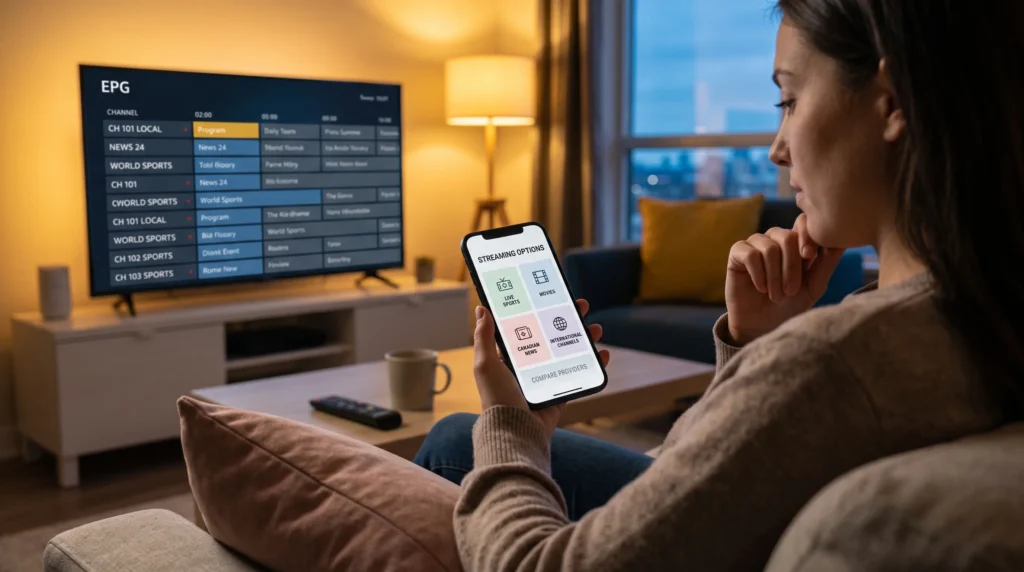
1. Understanding IPTV in Canada
IPTV stands for Internet Protocol Television. Instead of arriving through a coaxial cable, a satellite dish, or an over-the-air antenna, the picture is broken into data packets and delivered to your device over an internet connection.
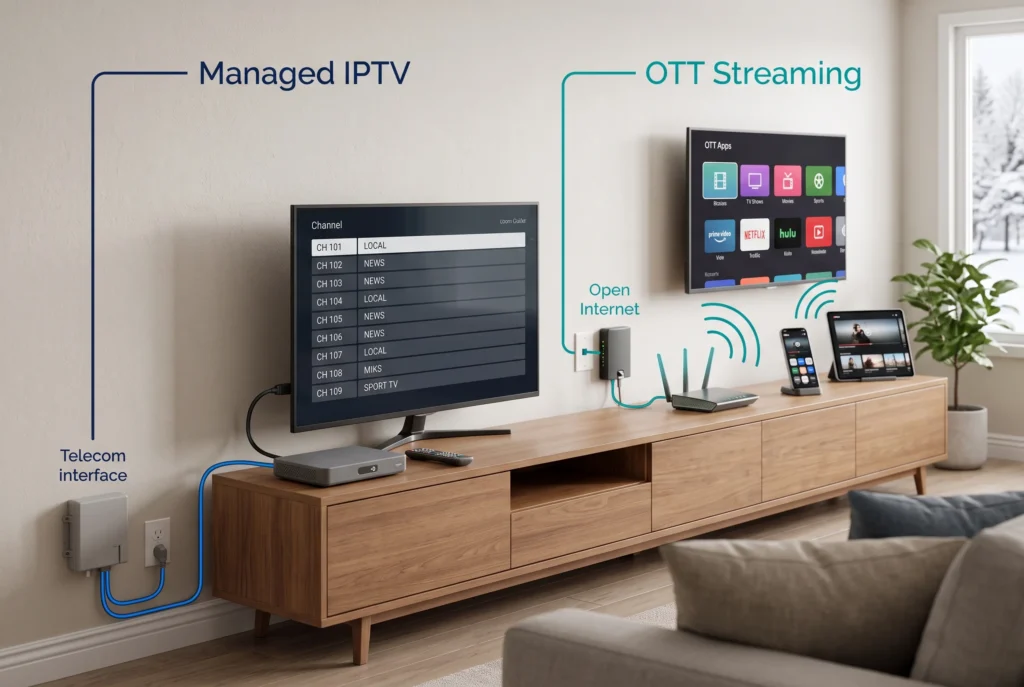
There are two broad flavours worth telling apart:
- Managed IPTV, delivered over a closed, dedicated network that a telecom controls end to end. Bell Fibe TV and Telus Optik TV are the clearest Canadian examples.
- OTT (over-the-top) streaming, delivered over the open public internet, the same pipe you use for browsing or email. Crave and RiverTV fall into this category.
Both rely on similar underlying video technology, such as HLS or MPEG-DASH, and both need reasonable bandwidth to look good: roughly 5–8 Mbps for HD and 15–25 Mbps for 4K.
Why does any of this matter right now? Because cord-cutting has become the norm rather than the exception in Canada. An estimated 48.5% of Canadian households were without a traditional cable, satellite, or telecom TV subscription by the end of 2025, according to Convergence Research’s annual “Couch Potato” report, and that number is projected to keep climbing. That shift toward flexible, internet-delivered TV is exactly why legal IPTV has expanded so much — and, unfortunately, why illegal alternatives have multiplied right alongside it.
1.1 What IPTV means and how it works
- IPTV sends content as IP packets to a set-top box, app, or connected device, rather than broadcasting it over the air on a fixed frequency.
- The CRTC recognizes IPTV as a legitimate method of delivering broadcasting distribution undertaking (BDU) services — it is simply one more way to get television into a home.
- The important nuance: IPTV describes a delivery method, not a content source. Whether a given IPTV service is legal depends entirely on whether it has the rights to the content it carries, not on the fact that it uses IP-based delivery.
- Common access points include dedicated set-top boxes (like a Fibe TV Box), smart TV apps, and streaming sticks such as Fire TV or Roku.
1.2 Why IPTV is popular among Canadian streamers
The appeal is easy to understand. Legal IPTV and streaming services tend to offer more flexible packages, lower entry prices than a full cable bundle, access across multiple devices, and no long-term contracts.
Live sports remains one of the biggest reasons people hang onto a traditional pay-TV subscription, which is exactly why legal IPTV options with genuine Sportsnet and TSN carriage — such as Bell Fibe TV or Rogers Xfinity TV — matter so much for Canadian sports fans looking to cut the cord without losing their games.
That same combination of low price and huge channel selection is also what draws some viewers toward unlicensed, grey-market IPTV services promising thousands of “worldwide” channels for a fraction of the cost. Before you’re tempted by one of those deals, it’s worth understanding exactly where the legal line sits.
2. Is IPTV Legal in Canada?
Here is the direct answer: yes, IPTV as a technology is fully legal in Canada. Canadian courts have already confirmed that set-top boxes and streaming devices have legitimate, everyday uses, and they cannot be banned simply because some people misuse them.
The real legal question is never about the delivery method. It’s about the specific service: does it actually hold the rights to the channels and programming it’s distributing? A provider using IPTV technology to deliver Bell Media or Rogers Sports & Media content under a proper agreement is no different, legally, from a cable company sending the same channels down a coaxial line.
Three pieces of federal legislation shape how this plays out in practice: the Copyright Act, the Broadcasting Act (as amended by the Online Streaming Act), and the Radiocommunication Act. Here’s how each one fits together.
2.1 How Canadian laws apply to IPTV services
| Law | What it covers |
| Copyright Act | Grants rights holders the exclusive right to communicate their works to the public. Section 31 provides a compulsory retransmission licence for real-time, unaltered signal retransmission, but explicitly excludes “new media retransmitters” whose service depends on being distributed over the public internet. |
| Broadcasting Act (as amended by Bill C-11, the Online Streaming Act) | Gives the CRTC jurisdiction over online broadcasting undertakings, including a revenue-based registration threshold for larger streaming and broadcasting services. |
| Radiocommunication Act | Makes it an offence to decode encrypted radio or satellite signals without authorization. |
Statutory damages for commercial copyright infringement in Canada range from $500 to $20,000 per infringed work, while damages for non-commercial infringement by an individual are capped much lower, generally between $100 and $5,000 in total. Federal Court decisions show these numbers can add up fast: two related 2024–2025 rulings involving unauthorized IPTV distribution of Turkish-language programming resulted in combined statutory damages of more than $33 million.
The law also has real enforcement teeth beyond damages awards. In Bell Media Inc. v. GoldTV.Biz, the Federal Court ordered major Canadian ISPs to block a pirate IPTV service’s domains and IP addresses, a decision upheld on appeal. In 2022, the Federal Court went further in Rogers Media Inc. v. John Doe, approving Canada’s first “dynamic” blocking order, which let rights holders update the list of blocked IP addresses in real time during live NHL broadcasts without returning to court each time.
2.2 Legal vs illegal IPTV: the key difference
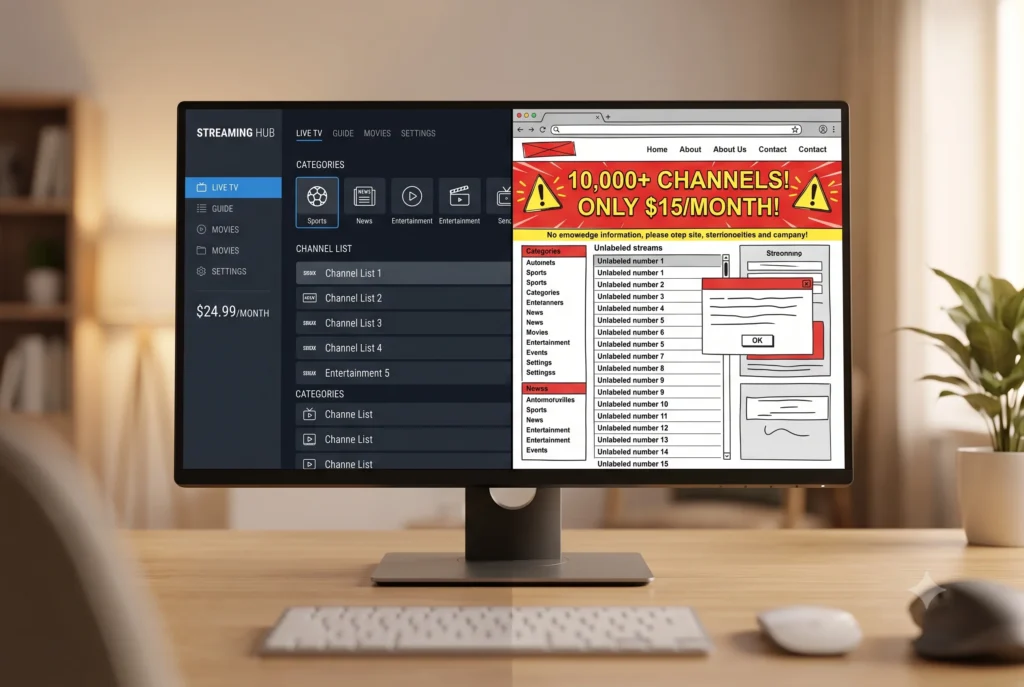
The core distinction is simple: a legal IPTV provider has paid for the rights to distribute the channels it carries. An illegal one hasn’t, no matter how professional its app or website looks.
| Signal | Legal IPTV | Illegal IPTV |
| Pricing | Realistic — typically $20–$80/month for a real channel package | Extremely low for the number of channels offered (e.g., “10,000 channels” for $15/month) |
| Company identity | Named, identifiable Canadian company, often tied to your ISP account | Anonymous operators, vague or missing company information |
| Domain/app stability | Stable, listed in official app stores | Frequently changing domains, sideloaded apps, “secret link” instructions |
| Payment methods | Credit card, standard billing | Crypto, e-transfer, or gift cards only |
| Geographic scope | Usually restricted to Canada, reflecting rights agreements | Marketed as “worldwide,” “all channels,” no restrictions |
The pricing math here isn’t just a value signal — it’s a legality signal. Real content licensing costs money, and a provider genuinely paying broadcasters and rights holders simply cannot profitably offer thousands of premium channels at rock-bottom prices.
3. What Makes an IPTV Service Legal in Canada?
In practical terms, a legal IPTV service needs to pass a two-part test: it must have the correct CRTC status, and it must have secured the actual rights to the content it distributes. The next two sections unpack each half of that test.
3.1 Licensing and broadcasting rights explained
There are two lawful paths to carrying broadcast content:
- Direct carriage agreements negotiated with the networks themselves — Bell Media, Rogers Sports & Media, Corus, and others — where the provider pays negotiated fees for the right to distribute specific channels.
- The Section 31 compulsory retransmission licence, which allows real-time, unaltered retransmission of over-the-air signals, provided the retransmitter pays the applicable Copyright Board tariffs and stays within the definition of a “retransmitter” rather than a “new media retransmitter” whose service depends on public internet distribution.
This licensing chain is precisely why “5,000 channels for $15 a month” is not a realistic offer from a legitimate provider. Between carriage fees, tariffs, and CanCon obligations, the underlying costs simply don’t support that kind of pricing at scale.
3.2 Role of the CRTC and Canadian regulations
The CRTC acts as referee between full broadcasting licences and smaller, exempt operations.
- Broadcasting Order 2017-320 exempts smaller broadcasting distribution undertakings, generally those with fewer than 20,000 subscribers, from full licensing requirements.
- Broadcasting Order 2012-409, the Digital Media Exemption Order, covers over-the-top and digital media broadcasting undertakings, though services that rely solely on this exemption are excluded from the Section 31 retransmission licence as “new media retransmitters.”
- The largest providers — Bell, Rogers, Telus — hold full broadcasting licences. Smaller independent providers typically register their exempt status with the CRTC.
- A consumer-facing signal worth checking: whether a provider is subject to the TV Service Provider Code and is a member of the Commission for Complaints for Telecom-Television Services (CCTS), which gives you somewhere to escalate a dispute.
4. Risks of Using Illegal IPTV Services
Risk here splits sharply along one line: are you a viewer, or are you a reseller running the service? The two groups face very different consequences.
4.1 Legal consequences for users and resellers

For ordinary viewers, Canada’s copyright enforcement leans on the notice-and-notice regime rather than direct prosecution. Rights holders generally cannot obtain a subscriber’s identity without a Norwich order from a court, individual damages are capped at a maximum of roughly $5,000 total for non-commercial infringement, and prosecutions of ordinary subscribers for merely watching an illegal service are effectively unheard of in Canada.
Resellers and operators face an entirely different reality, and Canadian courts have shown they take commercial-scale infringement seriously:
| Case | Outcome |
| TVAddons (Adam Lackman) | Consent judgment ordering payment of $25 million CAD to Bell, Rogers, Videotron, and TVA |
| L3D Distributing and related pirate box retailers | Federal Court awarded in excess of US$23.6 million in copyright damages |
| Beast IPTV (Tyler White) | Ordered to pay $7.1 million in penalties, plus 60 days’ incarceration for contempt of court after disobeying an interim injunction |
| GEM Action / GLWiZ Action (unauthorized IPTV distribution) | Combined statutory damages exceeding $33 million across two related 2024–2025 Federal Court rulings |
The pattern is consistent: reselling or operating an unlicensed IPTV service in Canada carries severe and escalating legal exposure, extending well beyond fines into personal liability and, in at least one case, jail time.
4.2 Security, privacy, and service reliability concerns
Beyond the legal risk, illegal IPTV carries practical downsides for subscribers. Devices associated with piracy streaming have been linked to significantly higher malware infection rates than mainstream streaming devices in independent research. Payment through cryptocurrency, e-transfer, or gift cards — the norm for unlicensed services — offers no chargeback protection if something goes wrong. And reliability is inherently precarious: when enforcement action shuts a service down, as happened with GoldTV and Beast IPTV, subscribers are typically left stranded overnight with no refund and no warning.
5. List of Legal IPTV Providers in Canada
Legal IPTV providers in Canada generally fall into two tiers: Tier 1 covers the major telecom-operated services with full CRTC broadcasting licences, while Tier 2 covers independent providers that are typically smaller or operate under a CRTC exemption order. Both tiers can offer genuine value — the difference is mainly about scale and ownership structure, not legitimacy.
5.1 Popular licensed IPTV services available in Canada
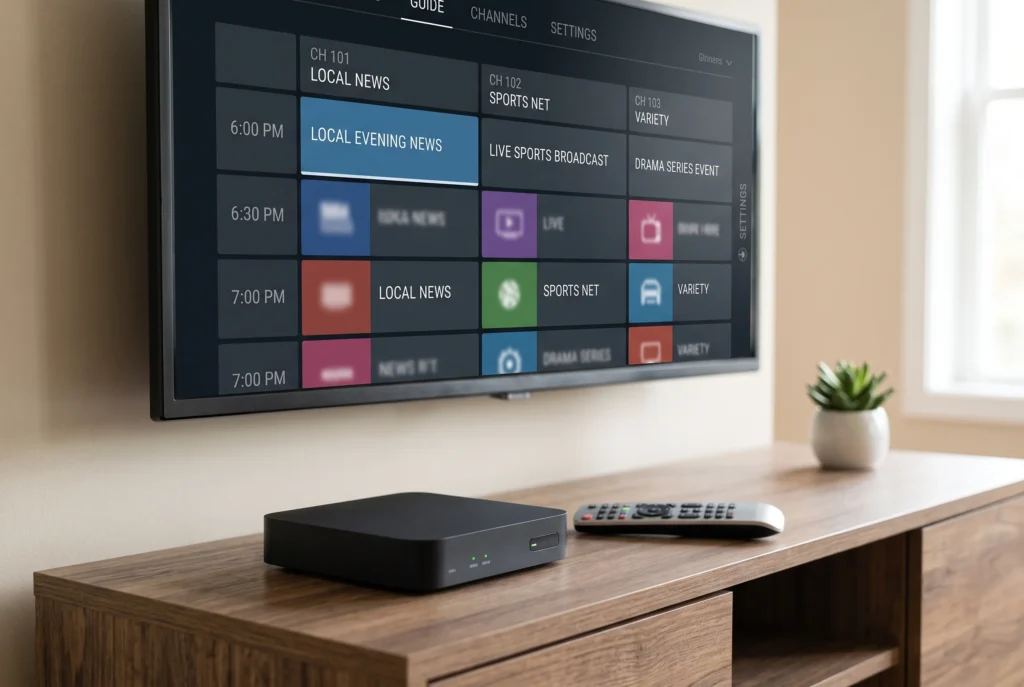
| Service | Tier | Type | Devices | Pricing notes | Key fact |
| Bell Fibe TV | 1 | Managed IPTV | Fibe TV Box, iOS/Android app | From roughly $35/month for a base package | Requires a Bell Internet subscription; no Firestick or third-party app support |
| Rogers Xfinity TV (formerly Ignite TV) | 1 | Managed IPTV | Xfinity gateway, iOS/Android app | Bundled with Rogers internet | Rebranded from “Ignite” to “Xfinity” in 2024–2025 under a technology partnership with Comcast |
| Telus Optik TV / Pik TV | 1 | Managed IPTV / streaming | Optik box, Pik TV app | Optik from ~$30/month; Pik TV offers a lower-cost, app-only option | Pik TV is Telus’s contract-free, app-based alternative to full Optik TV |
| Shaw TV (now part of Rogers) | 1 | Managed IPTV/cable | Shaw gateway | Bundled pricing | Shaw’s TV operations were absorbed into Rogers following the 2023 Shaw acquisition |
| VMedia TV | 2 | IPTV | VBox, Roku, Fire TV, Android TV | Build-your-own packages starting around $20/month | Brand continues to operate under Freedom Mobile/Videotron ownership after VMedia Inc. was formally wound down in 2025 |
| RiverTV | 2 | OTT streaming | Roku, mobile, web | Low-cost, skinny bundles | Launched by VMedia as a national, internet-only streaming service, not tied to a local internet subscription |
| TekSavvy TV | 2 | IPTV/streaming | App-based | Bundled with TekSavvy internet | Independent ISP offering, positioned as a lower-cost alternative to the major telecoms |
| Start TV | 2 | IPTV | App-based | Budget-tier pricing | Name can be confused with unrelated “Start.ca” or Telus-affiliated offerings — confirm exactly which company you’re signing up with |
| NetJOI TV | 2 | IPTV | App-based | Entry-level pricing | Newer entrant with a thinner public track record than longer-established independents |
| Virgin Plus TV | 2 | App-based streaming | App only, no set-top box | Bundled with Virgin Plus mobile/internet | Bell confirmed it will stop selling Virgin Plus Internet and TV in Ontario starting January 2026; Quebec availability continues for now |
Before you commit to any independent provider, it’s worth spending two minutes confirming current pricing and availability directly with the company, since promotions and lineups shift often in this segment.
5.2 How to verify if an IPTV provider is legal

- Check whether the provider is a licensed BDU or appears on the CRTC’s exempt-BDU registry.
- Confirm it has a real Canadian corporate registration and a physical business address.
- Look for named carriage partnerships with recognizable broadcasters (Bell Media, Rogers Sports & Media, Corus, and similar).
- Verify it accepts mainstream payment methods like credit cards, not only crypto or gift cards.
- Look for real customer support channels and an official presence in the Apple App Store or Google Play, rather than a sideloaded APK.
- Check whether it’s part of the CCTS complaint-resolution system.
- Run the pricing sanity check: genuine channel packages in Canada run roughly $20–$80 a month. Anything advertising thousands of channels far below that range is a red flag.
6. IPTV Boxes and Devices in Canada
6.1 Are IPTV boxes legal to own and use?
Streaming devices themselves — Fire TV, Apple TV, Roku, Android TV boxes, MAG boxes — are completely legal to own, import, and sell in Canada. Canadian courts have confirmed that a device with legitimate everyday uses cannot be banned outright simply because some users load it with unauthorized apps. What matters is what’s installed and streamed on the box, not the hardware itself.
6.2 Legal vs pre-loaded IPTV devices

There’s an important difference between an official provider device or app — a Fibe TV Box, a VMedia VBox, an official Fire TV app from a licensed service — and a “fully loaded” box that comes pre-configured with unauthorized streaming apps out of the box.
| Legal setup | Pre-loaded/piracy setup | |
| Source | Official provider hardware or app store listing | Reseller-modified box or sideloaded APK |
| Content rights | Licensed, carriage agreements in place | None; content is unauthorized |
| Seller exposure | None | Significant — sellers of pre-configured piracy boxes have faced multi-million-dollar judgments |
| Geo-restriction | Often restricts viewing to Canada, reflecting real rights agreements | Typically bypasses geo-restrictions entirely |
Sellers of pre-loaded piracy boxes face real legal exposure in Canada, as shown by the multi-million-dollar judgment against L3D Distributing and related retailers. It’s also worth noting that geo-restriction to Canada is actually a legitimacy signal rather than an inconvenience: licensed services restrict access outside Canada because that’s what their content rights require.
7. Tips for Choosing a Safe IPTV Service

7.1 Signs of a trustworthy IPTV provider
- Transparent company ownership information and a real Canadian address
- A clear, named channel lineup that matches real broadcasters you recognize
- Normal pricing structure — a base package plus optional add-ons, not one impossibly cheap all-in bundle
- Official presence in the Apple App Store or Google Play
- Geo-restriction to Canada, reflecting genuine content rights compliance
7.2 Red flags to avoid illegal services
- Marketing thousands of “worldwide” channels at prices far below what licensing would realistically cost
- No visible company name, address, or legal disclosures anywhere on the site
- Constantly rotating domains, renamed apps, or “secret URL” setup instructions
- Crypto-only or gift-card-only payment with no receipts or invoices
- Structure built around “reseller credits” or “lines,” a common pattern in unlicensed panel operations
8. Frequently Asked Questions
Is IPTV legal in Canada?
Yes — IPTV is legal when it’s offered by a properly licensed or rights-cleared provider. The technology itself isn’t illegal; legality depends entirely on whether the specific service has secured the rights to its content.
Is it illegal to watch IPTV in Canada?
Enforcement in Canada focuses almost entirely on the people operating unlicensed services, not individual viewers. There is some real but limited risk for viewers — notice-and-notice letters, sudden service disruption, and potential terms-of-service violations — but prosecution of ordinary subscribers is effectively unheard of.
What makes an IPTV service legal in Canada?
A two-part test: the provider needs the correct CRTC status (a full broadcasting licence or a valid exemption), and it needs to have actually secured the rights to distribute the content it’s carrying, either through direct carriage agreements or the Section 31 compulsory retransmission licence.
Can you get in trouble for using IPTV in Canada?
Risk is low for ordinary viewers and severe for resellers and operators. Canadian courts have handed down judgments in the tens of millions of dollars against IPTV resellers, and at least one operator has served jail time for contempt of court.
Are IPTV boxes legal in Canada?
Yes, the hardware is fully legal to own and sell. The legal risk lives entirely in what content is loaded onto or streamed through the box, not in owning the device itself.
9. Conclusion
IPTV itself is legal in Canada — the technology is simply a delivery method, and it’s the underlying service that determines whether you’re on solid legal ground. For anyone looking to cut the cord safely, the licensed options are genuinely competitive: Bell Fibe TV, Rogers Xfinity TV, Telus Optik/Pik TV, VMedia TV, RiverTV, TekSavvy TV, Start TV, NetJOI TV, and (for now, in Quebec) Virgin Plus TV all offer legitimate ways to watch. If you’re considering reselling or operating an IPTV service rather than simply subscribing to one, the stakes are dramatically different, and the legal exposure documented in Canadian courts should not be taken lightly. Whatever option you’re weighing, the practical takeaway is the same: verify a provider’s licensing status and pricing sanity before you subscribe, not after.


